Philips Certain CPAP or Bi-Level PAP therapy masks with magnetic headgear clips recall: potential risk of serious injury
potential risk of serious injury
The hazard: High-powered magnet hazard
The problem with this product is magnets coming loose. A magnet ingestion looks like an ordinary stomach upset for the first day or two, which is exactly why these recalls are issued.
What the notice says: As of August 30, 2022, Philips Respironics has received 14 reports of patients suggesting that the mask magnets may have impacted their medical devices including pacemaker interference, pacemaker failure leading to replacement, need of shunt adjustment, resetting of automatic implantable cardioverter defibrillator (AICD), seizures, defibrillator shutting off periodically, arrhythmia, irregular blood pressure, change in heartbeats, and cognitive issues.
Why it matters: Loose high-powered magnets are dangerous when more than one is swallowed. They attract each other through the walls of the intestine and pinch the tissue trapped between them, an injury that usually needs surgery.
Symptoms and when to call a doctor
If you think a child has swallowed magnets — even if they seem entirely well — go to an emergency department and say magnets are involved. Early symptoms are indistinguishable from a stomach bug: stomach pain, vomiting, poor appetite. A single magnet may pass on its own; two or more rarely do, and the team needs to know how many are unaccounted for.
This page is general information, not medical advice. If you feel unwell, a clinician who can see you is the only person able to judge your case.
Recall details
- Published
- September 6, 2022
- Risk level
- Highest risk
- Issued by
- U.S. Food and Drug Administration
- Brand
- Philips
- Product type
- Medical devices
Products covered by this recall
Certain CPAP or Bi-Level PAP therapy masks with magnetic headgear clips or straps
What the company announced
These masks may continue to be used according to the updated instructions and labeling if patients or people in close proximity to them do not have implanted metallic medical devices or metallic objects in the body.
Pittsburgh, Pennsylvania – Royal Philips ’ (NYSE: PHG; AEX: PHIA) subsidiary Philips Respironics is alerting users of certain CPAP or Bi-Level PAP therapy masks with magnetic headgear clips or straps that these devices should not be used by or near patients and their household members, caregivers and bed partners who have metallic implanted devices or metallic objects (such as metallic splinters) in the body. The magnetic headgear clips are used to attach the headgear straps to the masks, which is a method that is commonly used in the sleep therapy devices industry.
This is a voluntary notification to users of specific CPAP or Bi-Level PAP therapy masks containing such magnetic clips to inform them of the updated instructions and labeling. All users should read and follow Philips Respironics’ voluntarily updated warning and added contraindication described below. This represents a new and industry-leading practice.
Contraindication: Use of the mask is contraindicated for patients and their household members, caregivers and bed partners that may be in close vicinity to patients using the masks, that have implanted devices that may be affected by magnets, including but not limited to:
Pacemakers
Implantable cardioverter defibrillators (ICD)
Neurostimulators
Magnetic metallic implants/electrodes/valves placed in upper limbs, torso, or higher (i.e., neck and head)
Cerebral spinal fluid (CSF) shunts (e.g., ventriculo peritoneal (VP) shunt)
Aneurysm clips
Embolic coils
Intracranial aneurysm intravascular flow disruption devices
Metallic cranial plates, screws, burr hole covers, and bone substitute devices
Metallic splinters in the eye
Ocular implants (e.g., glaucoma implants, retinal implants)
Certain contact lenses with metal
Implants to restore hearing or balance that have an implanted magnet (such as cochlear implants, implanted bone conduction hearing devices, and auditory brainstem implants)
Magnetic denture attachments
Metallic gastrointestinal clips
Metallic stents (e.g., aneurysm, coronary, tracheobronchial, biliary)
Implantable ports and pumps (e.g., insulin pumps)
Hypoglossal nerve stimulators
Devices labeled as MR (Magnetic Resonance) unsafe
Magnetic metallic implants not labeled for MR or not evaluated for safety in a magnetic field
Patients should stop using the affected mask if the implant/medical device is contraindicated against the mask magnets. Patients should consult their physician immediately to determine if another mask can be used for their therapy. In the interim, switch to a non-magnetic mask if available, for continued therapy. Patients should properly dispose of the mask that has magnets after an alternative is obtained.
These masks may continue to be used according to the updated instructions and labeling if patients or people in close proximity to them do not have implanted metallic medical devices or metallic objects in the body.
Warning: Magnets with a magnetic field strength of 400 mT are used in the mask. With the exception of the devices identified in the contraindication, ensure that the mask is kept at least 6 inches (approx. 15 cm) away from any other medical implants or medical devices that can be impacted by the magnetic fields to avoid possible effects from localized magnetic fields. This includes household members, caregivers, and bed partners that may be in close vicinity to patients that use the masks.
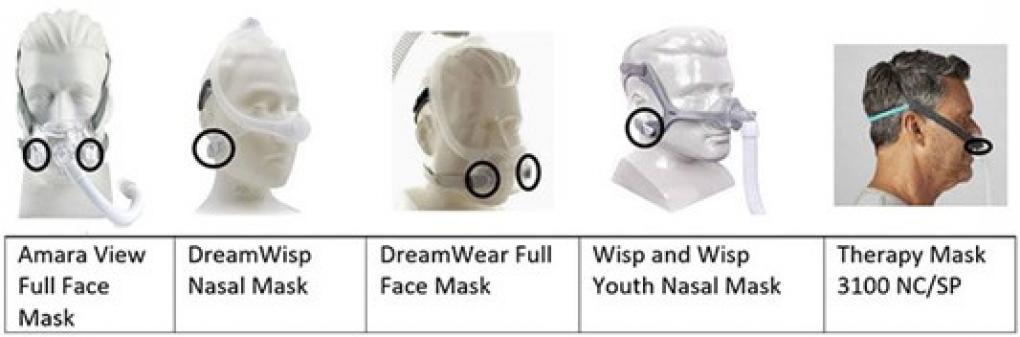
Impacted masks include: See Image Below
More than 17 million masks containing magnetic clips have been distributed by Philips Respironics to date. As of August 30, 2022, Philips Respironics has received 14 reports of patients suggesting that the mask magnets may have impacted their medical devices including pacemaker interference, pacemaker failure leading to replacement, need of shunt adjustment, resetting of automatic implantable cardioverter defibrillator (AICD), seizures, defibrillator shutting off periodically, arrhythmia, irregular blood pressure, change in heartbeats, and cognitive issues.
Patients with questions may contact Philips Respironics’ customer service at 1-800-345-6443, (Monday – Friday; 8:30 AM ET to 8:00 PM ET) for more information about non-magnetic mask options. Patients may also contact their Durable Medical Equipment (DME) provider, which supplied the masks affected by this notice.
Any adverse events experienced with the use of masks containing magnetic clips should be reported to the FDA’s MedWatch Program by phone at 1-800-FDA-1088, by fax at 1-800-FDA-0178, by mail at MedWatch, HF-2, FDA, 5600 Fishers Lane, Rockville, MD 20852-9787, or on the MedWatch Web site at www.fda.gov/medwatch .
This voluntary medical device corrective action has been reported to the regulatory agencies in the countries where these masks are available.
An FAQ can be found here .
FDA Safety Communication
FDA News Release
Reproduced from the company announcement posted on fda.gov. Links and contact forms in the original are not repeated here; the official notice below has them.
What to do about Magnets
Philips — The problem with this product is magnets coming loose. A magnet ingestion looks like an ordinary stomach upset for the first day or two, which is exactly why these recalls are issued.
- Put the product out of reach and count the magnets against the number the instructions say it should have.
- Follow the remedy described on this page rather than keeping the item with the magnets glued back in.
- Check under furniture and along skirting boards — stray magnets travel further than you would expect.
- If any are unaccounted for and a child could have reached them, go to an emergency department and tell them magnets may have been swallowed.
If the claim stalls
Most recall claims are paid without argument. The ones that stall usually stall for a reason you can fix.
- Check you used the recall channel rather than ordinary customer support — the two queues rarely talk to each other.
- Give it ten working days, then chase in writing and quote your claim reference.
- If the company is unresponsive or has stopped trading, report it to the CPSC at SaferProducts.gov, and try the retailer in parallel.
- Paid by card? A chargeback for goods that are unfit for sale is a legitimate fallback once the company has had a fair chance.
Remedy named in the notice: Patients should properly dispose of the mask that has magnets after an alternative is obtained.
Company contact: Royal Philips’ subsidiary Philips Respironics — Consumers: Philips Respironics’ Customer Service, 1-800-345-6443 — Media: Mario Fante, Philips Global Press Office, 1 603 560 9226
The official notice
This page summarises a notice published by U.S. Food and Drug Administration. The agency notice is the authoritative version — read it before you act, and treat it as the final word if anything here looks different.
Open the FDA — Company recall announcements record U.S. Food and Drug Administration recalls
Questions people ask about this recall
Why was Philips medical devices recalled?
potential risk of serious injury As of August 30, 2022, Philips Respironics has received 14 reports of patients suggesting that the mask magnets may have impacted their medical devices including pacemaker interference, pacemaker failure leading to replacement, need of shunt adjustment, resetting of automatic implantable cardioverter defibrillator (AICD), seizures, defibrillator shutting off periodically, arrhythmia, irregular blood pressure, change in heartbeats, and cognitive issues.
How do I know if I have the recalled product?
The notice does not publish package codes for this recall. Compare the product name, size and the purchase window against the official FDA — Company recall announcements record, and contact the company if you are unsure.
What should I do with it right now?
Put the product out of reach and count the magnets against the number the instructions say it should have.
Can I get my money back?
The notice says: Patients should properly dispose of the mask that has magnets after an alternative is obtained.
Related recalls
-
Class II · 10 days ago
Howmedica Osteonics Corp. TS Universal Baseplate Finishing Tray, Triathlon recall: Reprocessing instructions provided in LSTPI-B specify a sterilization dry
Reprocessing instructions provided in LSTPI-B specify a sterilization dry time of 30 minutes for the trays sterilized in blue wrap. When blue wrap is…
-
Class II · 10 days ago
Ferno-Washington Inc Power F2 Powered Fastening System, Power F2 recall: Firmware issue may result in intermittent loss or degradation of powered
Firmware issue may result in intermittent loss or degradation of powered functionality when paired with compatible stretcher. The issue may lead to…
-
Class II · 10 days ago
Howmedica Osteonics Corp. Triathlon Hinge Femoral Prep Tray recall: Reprocessing instructions provided in LSTPI-B specify a sterilization dry
Reprocessing instructions provided in LSTPI-B specify a sterilization dry time of 30 minutes for the trays sterilized in blue wrap. When blue wrap is…
-
Class II · 10 days ago
Medline surgical convenience kits labeled as: 1) Open Heart Pack A & recall: Medical convenience kits were distributed containing cannula components
Medical convenience kits were distributed containing cannula components which do not conform to ISO 80369-7 dimensional requirements and may…
-
Class I · 10 days ago
Instrumentation Laboratory HemoslL AcuStar HIT-lgG recall: Potential for invalid calibration curve or negative mean bias of up to 47%
Potential for invalid calibration curve or negative mean bias of up to 47% with patient samples.
-
Class II · 10 days ago
Cook Incorporated Williams Cystoscopic Injection Needles recall: The female Luer lock adapter component in the affected device lots
The female Luer lock adapter component in the affected device lots may not have been correctly seated due to misalignment and inadequate torquing…